PoolAcrylic on canvas
Black bodies at rest in bright water. Leisure, ease and pleasure, painted at full saturation and without apology.
Portraits on wood, cork, canvas and paper.
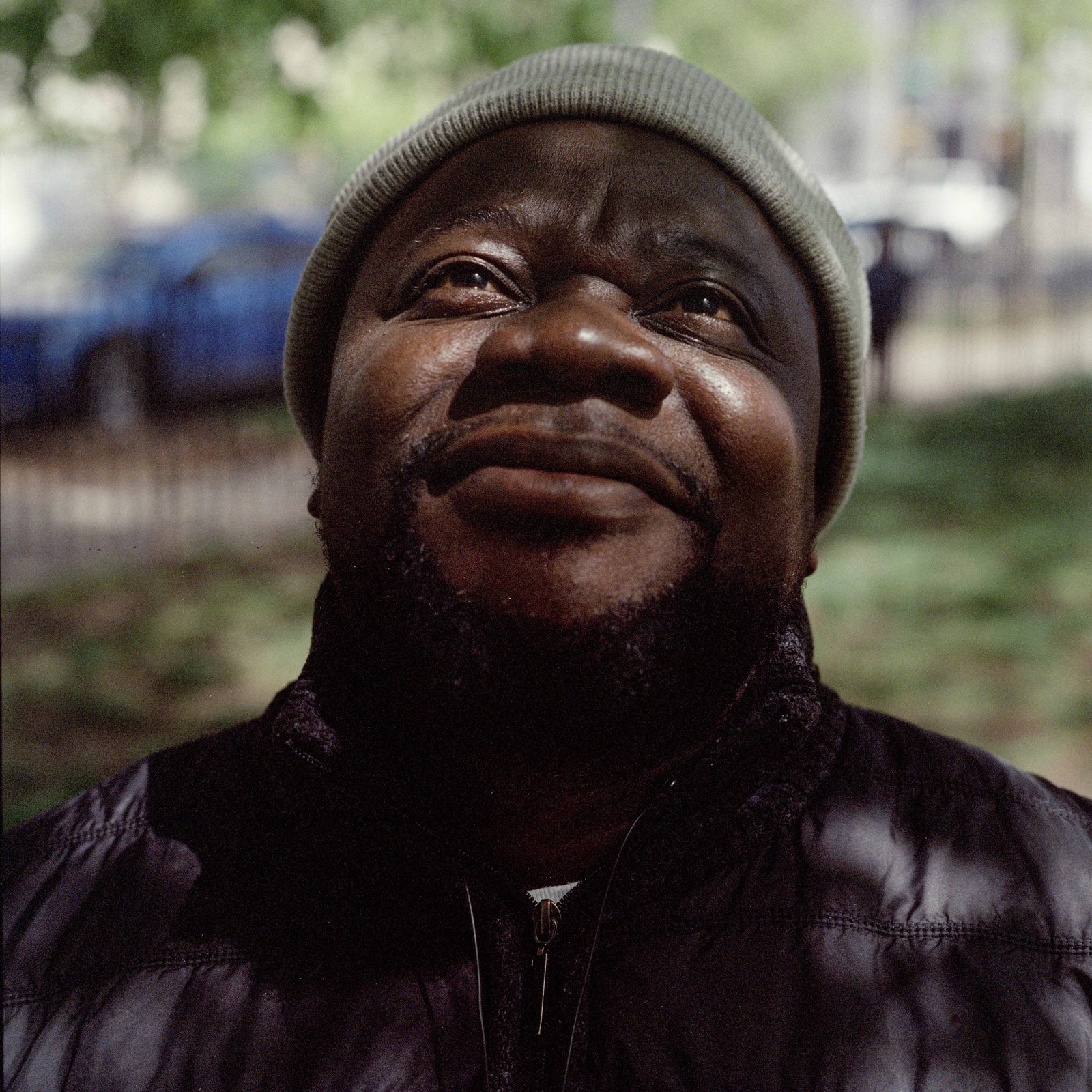
Musah Swallah paints people as they actually live: their style, their hair, their ambitions, the pressure and the pleasure of the city around them.
He works on canvas and paper, on repurposed wooden boards cut to the shape of the figure, and on surfaces built from thousands of wine corks. The support is never hidden. A split in the grain, a knot or a rough edge stays in the picture and becomes part of how it is read.
Black bodies at rest in bright water. Leisure, ease and pleasure, painted at full saturation and without apology.
Barbershops, bedrooms and living rooms: the places where style is made and worn. Figures hold the viewer's eye and give nothing away.
Boards saved from the street are cut to the silhouette of the sitter. The grain, the knots and the sawn edge stay visible, and the pattern of a shirt or a headwrap runs straight into the pattern of the wood.
Faces built from thousands of wine corks, each one a dot of tone. Up close, waste; at a distance, a likeness.
Heads against ochre, kraft and grey grounds, with the smallest signs of adornment: an earring, a collar, a line of hair. The quietest series, and the most direct.
Baba Musah Swallah was raised in Nima, a dense and largely Muslim neighborhood at the center of Accra, where families of different faiths and ethnic groups have lived together for generations. He studied visual arts at La Presec Senior High School from 2003 to 2006, and at the same time apprenticed with two artists from his own community, Mozzay and Akirash.
That apprenticeship shaped everything that followed. He learned painting the way it is still passed on in Accra, hand to hand, in working studios, and he has spent his career passing it on in turn.
For Swallah, a painting is a way to say something in public: to make people visible, to start a conversation and to change what a place believes about itself. He has painted murals, shown in Ghana, Côte d'Ivoire, Washington, DC, New York, Cleveland, Detroit and London, and completed residencies in Italy, Kenya and Côte d'Ivoire. His work has been featured on CNN and France 24.
He moved to the United States in 2017 and took part in the New York Foundation for the Arts Immigrant Artist Mentoring Program. He lives and works in Brooklyn.
In 2011 Musah and a group of artists from Nima founded Nima Muhinmanchi Art (NMA), a nonprofit that uses public art and education to change how the neighborhood is seen and how its public space is used.
As Artistic Director he has led free Saturday workshops in drawing and painting for young people whose talent had nowhere else to train, and murals that turned walls across Nima into shared property. Visitors to the neighborhood have noticed that the murals stay untouched by graffiti, which says something about who they belong to.
He has painted at Accra's Chale Wote Street Art Festival every year since 2011.
Musah is a Visual Arts Teacher at Lenox Hill Neighborhood House in New York, where he joined the faculty in 2020 and has led classes since 2022. He has taught young people in New York, Washington, DC, and Maryland, and served as artist-in-residence at a school in Washington, DC.
His work lands like weather, not spectacle.
For available work, acquisitions, commissions, murals, studio visits in Brooklyn and teaching residencies.